Energy Node
Energy monitoring and automation for a remote site — a workshop, barn, garage or second property that has its own solar, battery and switchable loads, but no reliable place to run a full home-automation stack.
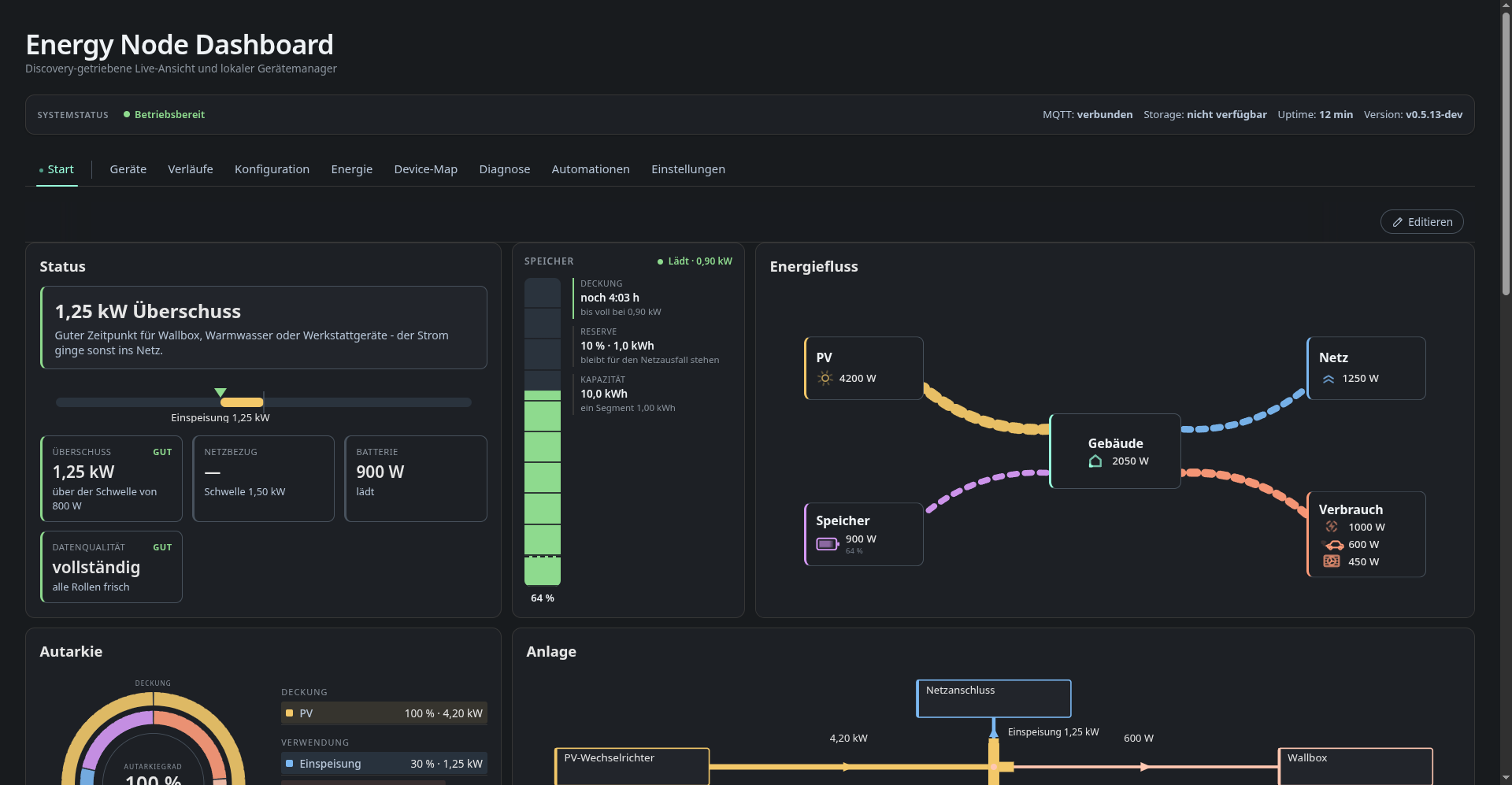
Energy Node turns a single small Linux box at that site into a self-contained node: it polls the local devices, publishes them as Home Assistant MQTT Discovery entities, runs its own automation rules, serves its own web dashboard — and mirrors everything over a VPN to the Home Assistant instance at the main site.
It is developed and run on a Raspberry Pi 1 Model B (ARMv6, single core, 512 MB RAM). Newer models work as well; the Pi 1 is the floor every design decision is measured against.
Start here
The dashboard, page by page — every screen of the web UI with a screenshot: overview cards and the layout editor, devices, browser-side history, the configuration editor, energy roles, device map, diagnostics, automations, all seven settings tabs and the four colour schemes.
Device services — what each service talks to and what it publishes: Shelly, APsystems EZ1, Trucki sticks, Tuya, the computed battery state of charge, the automation engine and the node’s own diagnostics — plus the conventions they all share.
Deploying a node — the installer, a desktop program that sets a node up on a Raspberry Pi, updates it and diagnoses it, screen by screen.
How it fits together
Everything couples through exactly one local MQTT broker. There is no direct HTTP path between the device bridges and the dashboard.
flowchart LR
    subgraph Remote["Remote site — Raspberry Pi 1 (ARMv6)"]
        DEV["Shelly · Tuya · APsystems EZ1<br/>Trucki stick · LiFePO4 banks"]
        BR["Python bridges<br/>(one systemd service each)"]
        MQ{{"Mosquitto<br/>localhost:1883"}}
        AUT["Automation service"]
        DASH["Go dashboard<br/>:8080 / Caddy :443"]
        DEV --> BR --> MQ
        MQ <--> AUT
        MQ --> DASH
    end

    MQ <-->|"outstation/# over Tailscale"| HA

    subgraph Main["Main site"]
        HA["Home Assistant<br/>+ Mosquitto"]
    end
Three properties shape the whole design:
- Local autonomy. Broker, bridges, automations and dashboard all run at the remote site. If the VPN, the internet or the main site goes down, the node keeps measuring, keeps its rules running and keeps its dashboard reachable on the local network. Every device is polled locally — no cloud account.
- One narrow link to the main site. A Mosquitto bridge over a
Tailscale tunnel mirrors exactly one topic tree,
outstation/#. Home Assistant picks the devices up through normal MQTT Discovery. No port forwarding, no exposed broker. - Old hardware is the point. Running well on ARMv6 is a hard requirement: one statically linked Go binary without CGO, no SQLite, no server-side history, no plugin system, no CDN assets, and chart history kept in the browser’s IndexedDB rather than on the node.
Knowledge base
Reference material, grouped the same way as the sidebar: general topics that
span the node, then the dashboard, then the device services under src/.
General
- Data flows — what data is produced where, which channels it travels through, and who consumes it
- Configuration — every field of the central
config.json - Performance and resources — measured CPU/RAM per service on the Pi 1, and the optimisations that follow
- Cutting a release — the tag-driven build-and-publish
workflow and how to publish
vX.Y.Z
Dashboard
- HTTP API — the dashboard’s
/api/v1, endpoint by endpoint - Reverse proxy — running the dashboard under a sub-path behind another proxy
- Secrets and credentials — where credentials live on the node and how they are installed
- Lazy assets and cache busting
— the frontend’s manual
?v=asset versioning - Updater job protocol — how the dashboard hands a local redeploy to the root updater unit
Services
- Battery state of charge — how the LiFePO4 engine works
Integration
- battery_soc HA mirror — the
battery_soccustom integration, its public HACS mirror repo and release runbook
Installation is documented in INSTALLATION.md in the repository; it covers
the ARMv6 specifics, including the packages that must be installed in an
outdated version first and updated afterwards.
A note on language
The project started as a single-site tool before it was made public. The dashboard’s UI — templates, JS strings, the automation editor — is currently German-only, as are most in-code comments across the Go and Python source. This documentation is written in English. A localization layer is planned but not yet implemented; until then, changing the displayed language means editing the embedded templates.
About
This is a history-free release of a private project, published as a working reference rather than as a product: it is shaped by one specific site’s hardware. Forking and adapting is the expected way to use it. MIT licensed.